Extend the video to 30 seconds with Seedance 2.5
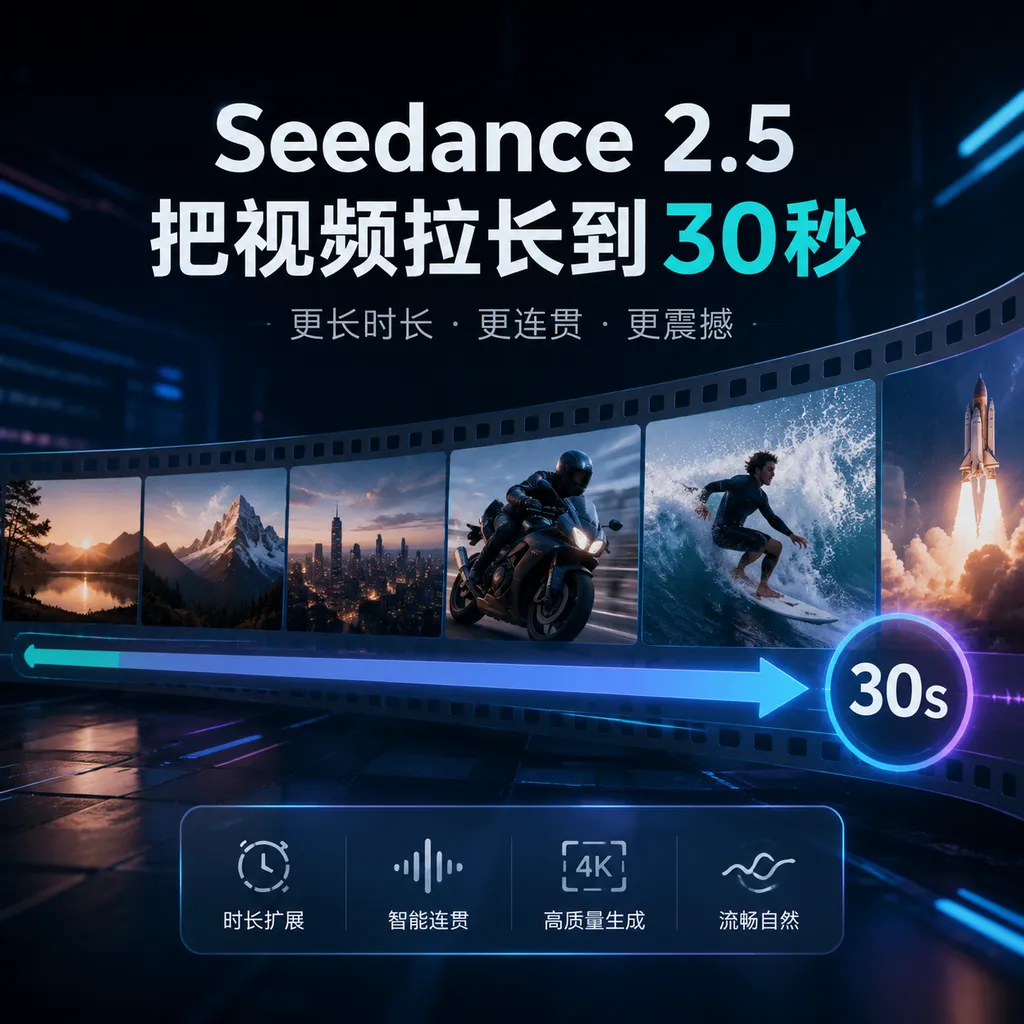
ByteDance has officially released Seedance 2.5, doubling the maximum video generation length from 15 seconds to 30 seconds while enhancing long-form storytelling, multimodal referencing, and continuous editing capabilities. The model is gradually rolling out to Jimeng AI and Doubao Pro, with API access coming soon to Volcano Ark.
Seedance 2.5 Officially Launches, and the Key Upgrade Is More Than “15 Extra Seconds”
On July 31, ByteDance officially launched Seedance 2.5, its next-generation video creation model. The new model is gradually rolling out to Jimeng AI and the premium version of Doubao, while API services for developers and enterprises will soon become available through Volcano Engine’s Ark platform.
The most immediately visible upgrade is that the maximum duration of a single generated video has doubled from 15 seconds in Seedance 2.0 to 30 seconds. The model can also extend existing videos. But interpreting this update merely as “doubling the duration” would underestimate the problem ByteDance is actually trying to solve: Seedance 2.5 aims to move video models from generating an attractive shot to producing a complete, deliverable piece of content.
Those are not the same thing.
Previous video generation models excelled at producing a few seconds of visual spectacle: a person turning around, a car drifting, or a spaceship passing through the clouds. The results were eye-catching and well suited to demos. But once a model was required to maintain character identity, spatial relationships, camera movement, dialogue pacing, and sound-effect continuity over dozens of seconds, errors quickly accumulated. A character’s face might change after a cut, a prop might suddenly disappear, or ambient sound might fall out of sync with the visuals.
Thirty seconds, therefore, is not simply a 15-second result played twice. It is a stress test of the model’s temporal modeling, cross-shot consistency, and joint audio-video generation capabilities.
From “Generating Clips” to “Structuring Narratives”
Seedance 2.5 retains Seedance 2.0’s unified multimodal architecture for joint audio-video generation, with a particular focus on improving long-form narrative, multimodal reference, and editing capabilities. According to ByteDance, the new model can organize multiple logically connected shots within 30 seconds, giving content setup, progression, a turning point, and a conclusion rather than merely producing a continuous sequence of motion.
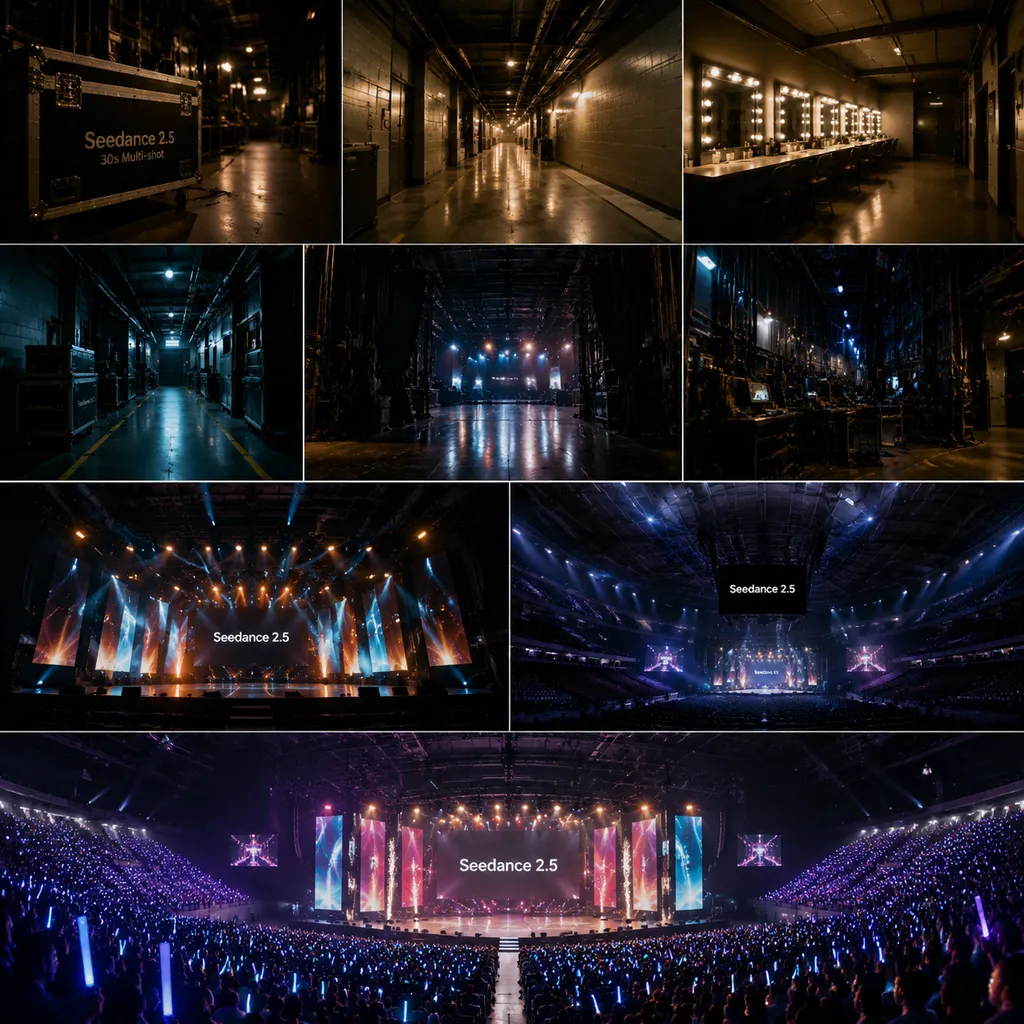
An official demo showing a singer taking the stage illustrates this goal clearly. The camera first passes through a gap in a red curtain into a backstage dressing room, where the singer adjusts an earpiece and receives a cue from a staff member to go onstage. The singer then walks through a backstage corridor, interacts with backup dancers, and takes a microphone. Finally, the singer steps onto the stage as the camera pulls back to a panoramic view of the arena, accompanied by the audience, illuminated signs, glow sticks, and cheering.
What truly matters in this example is not how sophisticated the stage lighting looks, but whether the model can handle a chain of interdependent state changes:
- Whether the singer remains the same person across different spaces and shot scales;
- Whether props such as the earpiece and microphone persist instead of appearing or disappearing out of nowhere;
- Whether the backstage area, corridor, and stage form a plausible spatial relationship;
- Whether camera movement, character actions, music, and ambient sound align on the same timeline;
- Whether the story genuinely completes the sequence of “preparation—movement—stage entrance—reveal.”
This also explains why the difficulty of long-video generation does not increase linearly with duration. With every additional second generated, the model must carry forward the character, scene, and action states established earlier. The longer the video, the more likely potential errors are to compound. For 30-second content, the model must not only remember what happened at the beginning but also understand which elements should be resolved by the end.
Judging from the official demos, Seedance 2.5 has begun treating “making each shot look good” and “finishing the story” as a single objective. However, handpicked official examples only demonstrate the upper bound of the model’s capabilities; they do not represent its average success rate with ordinary prompts. Character drift, continuity errors in actions, subtitle and lip-sync stability, and adherence to complex instructions will still require broader real-world testing.
Multi-Round Extension Tests Consistency More Than a Single 30-Second Generation
In addition to natively generating 30-second videos, Seedance 2.5 supports multi-round extension. Users can continue generating new 30-second segments from existing footage while instructing the model to preserve the characters, setting, visual style, voices, and sound effects.
In an official example, a young boy holding a soccer ball runs through a subway car. After the train stops, he rushes out through the doors, and the male protagonist gives chase and eventually catches him. This kind of continuous action may look less spectacular than a stage performance, but it is more likely to expose the model’s weaknesses: the positions of the subway car and platform must connect logically, the characters’ running direction cannot suddenly reverse, the soccer ball must remain with the same character, and the sequence of the train stopping, the doors opening, and the chase beginning cannot become confused.
If multi-round extension proves sufficiently stable, its practical value could exceed that of “a single 30-second generation.” Creators would not need to gamble on generating an entire long video in one attempt. Instead, they could generate one segment, confirm that the characters and shots meet expectations, and then continue expanding the story. This more closely resembles segmented shooting in real-world production and is better suited to workflows involving human review, partial regeneration, and post-production editing.
However, one key question remains unanswered by publicly available data: how many rounds can consistency be maintained? A successful first extension does not mean that the same faces, clothing details, and vocal characteristics will remain intact after three or five consecutive extensions. If errors accumulate after each generation round, multi-round extension may still result in “the earlier segment is usable, but the later one must be redone.”
Determining whether this capability is ready for production therefore requires looking beyond the maximum duration. Three metrics matter: the success rate of consecutive extensions, the rework cost after a localized failure, and the extent to which regeneration disrupts content that has already been approved.
Up to 50 Reference Assets per Generation, Shifting Control from Prompts to Materials
Seedance 2.5 supports up to 30 images, 10 videos, and 10 audio clips in a single input, for a total of 50 reference assets. The model can interpret their composition, settings, styles, characters, props, actions, and sounds collectively, then organize them into a new video according to text instructions.
For professional content creation, this upgrade may be no less significant than doubling the duration.
Pure text prompts are suitable for expressing abstract requirements such as “cinematic,” “cool color palette,” or “fast dolly-in,” but they struggle to precisely describe a character’s facial features, a product’s structure, brand-mandated colors, or the exact point at which a piece of music should begin. Reference assets effectively provide the model with a set of visual and audio constraints, eliminating the need to compress every requirement into words.
For example, in advertising production, a team could simultaneously provide product images, an actor’s approved look references, scene concept art, camera-movement references, brand music, and sample narration, then ask the model to generate a 30-second draft. For film and television previsualization, the inputs could include character designs, storyboard sketches, location photos, and action references. Industrial manufacturing, autonomous driving, and embodied AI applications could use equipment appearances, operating procedures, and environmental videos to generate content for demonstrations, training, or simulation.
ByteDance also demonstrated a multi-performer concert scene. The reference assets covered a pianist, cellist, violinist, lead singer, orchestra, choir, and audience, ultimately producing a cinematic, photorealistic video in a 16:9 landscape format. Scenes with multiple people in the same frame have always been especially challenging for video models because the model must not only reproduce each person individually but also prevent identity swaps, blended faces, and mismatched voices.
However, support for up to 50 assets does not mean that the model can control all 50 with equal precision. Developers need to know how the model prioritizes conflicting reference information; whether it can establish a stable identity when given photos of the same person from multiple angles; whether audio references control timbre, rhythm, or specific content; and whether video references transfer actions and camera movement or also replicate the original composition.
The answers will determine whether multimodal reference is merely a feature for “uploading more attachments” or a genuine control interface that can be integrated into production pipelines.
Thirty Seconds Reduces Editing Costs but Amplifies Generation Costs
The immediate benefit of Seedance 2.5 is that it reduces the need to stitch together short clips.
Previously, creating an advertisement or narrative short film from clips of 15 seconds or less usually required creators to generate multiple shots separately, then use editing software to manage character continuity, color grading, transitions, and sound. If a single 30-second generation can reliably accommodate multiple shots, the model effectively takes on part of the work of the director, storyboard artist, and rough-cut editor.
However, doubling the generation duration also introduces new engineering challenges.
The first is latency and cost. A 30-second video requires the model to process more temporal information, potentially increasing inference compute, generation wait times, and the cost of retrying failed outputs. For businesses producing content at scale, a more complete-looking individual draft does not necessarily translate into a lower cost per usable video.
The second is the cost of failure. If an error occurs in the final second of a five-second video, regenerating it is relatively inexpensive. If a character becomes distorted at the 28-second mark of a 30-second video, whether the preceding correct content can be preserved directly determines the tool’s usability. Professional users do not want to “reroll” the entire result every time. They need to lock approved sections and modify only the incorrect shot or specified region.
The final challenge is content safety and copyright identification. As the number of input assets increases, issues involving personal likenesses, music rights, trademarks, and the provenance of training data become more complex. Whether the enterprise API provides asset review, watermarking, generation logs, and permission isolation will also affect whether it can be used in formal advertising, film, television, and educational projects.
In other words, 30-second generation brings video models closer to producing finished content, but it also makes them more like production systems that must manage cost, versioning, and compliance risks.
The API Is Coming to Volcano Engine Ark, but It Is Too Early to Assess Integration Costs
ByteDance has confirmed that Seedance 2.5’s API service will soon launch on Volcano Engine Ark. As of July 31, the company has not disclosed a specific API release date, pricing, resolution and frame-rate tiers, concurrency limits, task timeout periods, or complete parameter documentation in its launch announcement.
It is therefore premature to provide speculative integration code, and the full set of capabilities demonstrated in consumer products should not be assumed to be available in the initial API release. Video model APIs typically use asynchronous tasks: the client first submits text and reference assets, the server returns a task ID, and the client then polls or waits for a callback to retrieve the result. Whether Seedance 2.5 will follow this model—and how multi-round extension, multi-person voice references, and editing capabilities will map to API parameters—must be confirmed through the official Volcano Engine Ark documentation.
Teams preparing for integration can begin by clarifying several requirements:
- Whether native 30-second generation is necessary or batch generation of shorter shots is more economical;
- How reference images, videos, and audio should be stored, uploaded, and access-controlled;
- How to retry jobs after generation failures, content-moderation rejections, or timeouts;
- Whether fixed random seeds, character IDs, or project-level asset libraries are required to maintain consistency;
- Whether output videos can be used commercially and how watermarking and copyright rules will be handled.
If Seedance 2.5 later provides a stable, standardized interface, aggregation platforms will be able to build unified integrations around it. OpenAI Hub can currently be used to access multiple leading models through a unified interface, but whether and when Seedance 2.5 will be supported should depend on the official API launch and actual integration results. “Coming soon to Volcano Engine Ark” should not be treated as equivalent to immediate cross-platform availability.
ByteDance Is Competing for the Video Production Gateway, Not the Longest Duration
From an industry competition perspective, the most aggressive aspect of Seedance 2.5 is not the 30-second figure itself. Duration records for video models can easily be broken by the next round of product updates. The real competitive moat lies in whether long-term consistency, asset-level control, a closed-loop editing workflow, inference costs, and platform distribution can all work together.
ByteDance has clear advantages in product synergy across these areas: Jimeng AI serves creators, Doubao’s premium version reaches a broader base of content users, and Volcano Engine Ark provides APIs for enterprises and developers. If the same model can rapidly gather real-world feedback from consumer products and then enter advertising, education, film, and television workflows through a cloud platform, it can iterate faster than a model offered only as a technical demonstration.
Seedance 2.5 also reflects a shift in how video generation models are evaluated. Early comparisons focused on single-frame visual quality and range of motion. Now, they increasingly assess whether a model can understand complex reference materials, maintain multiple characters, coordinate camera direction, and allow users to continue making revisions. Generating a stunning sequence remains important, but for production teams, being able to “do it again under control” is often more valuable than “getting it right once by chance.”
Our assessment is that Seedance 2.5 moves Chinese video models one step closer to becoming practical tools for long-form narrative content. Native 30-second output and support for 50 multimodal reference assets also directly address two major pain points in content production. However, whether it has truly crossed the gap from impressive demos to real productivity will depend on API pricing, average generation quality, the success rate of localized editing, and stability after multiple rounds of extension.
Today’s launch answers the question of whether the model can generate longer videos. What will ultimately determine Seedance 2.5’s competitiveness is whether errors can be corrected at low cost—and whether the economics still make sense at scale.
References
- ITHome: ByteDance Launches the Seedance 2.5 Video AI Model—Covers the model’s official launch, 30-second generation, multi-round extension, multimodal reference capabilities, and the planned release of its API on Volcano Engine Ark.