OpenAI Astra Targets Long-Horizon Tasks
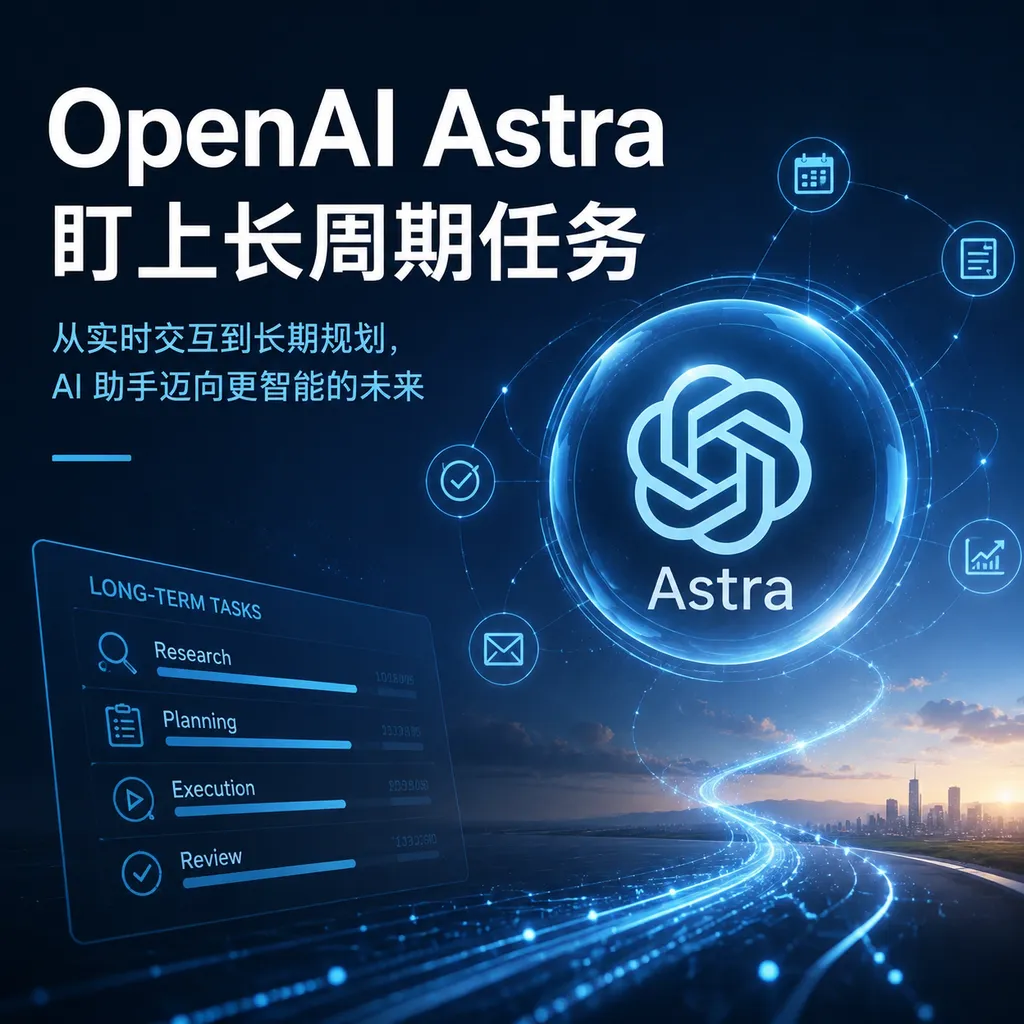
OpenAI is reportedly showcasing its Astra model, which uses multiple agents to divide and parallelize tasks, shifting the goal from one-off Q&A to complex work that can continue for hours or even longer. The real test lies not in the number of agents, but in the reliability, cost, and governance of long-horizon execution.
OpenAI Astra Sets Its Sights on Long-Horizon Tasks
OpenAI is pushing the agent race beyond “clicking the mouse a few times for users” toward “having a group of AIs continuously complete an entire project.”
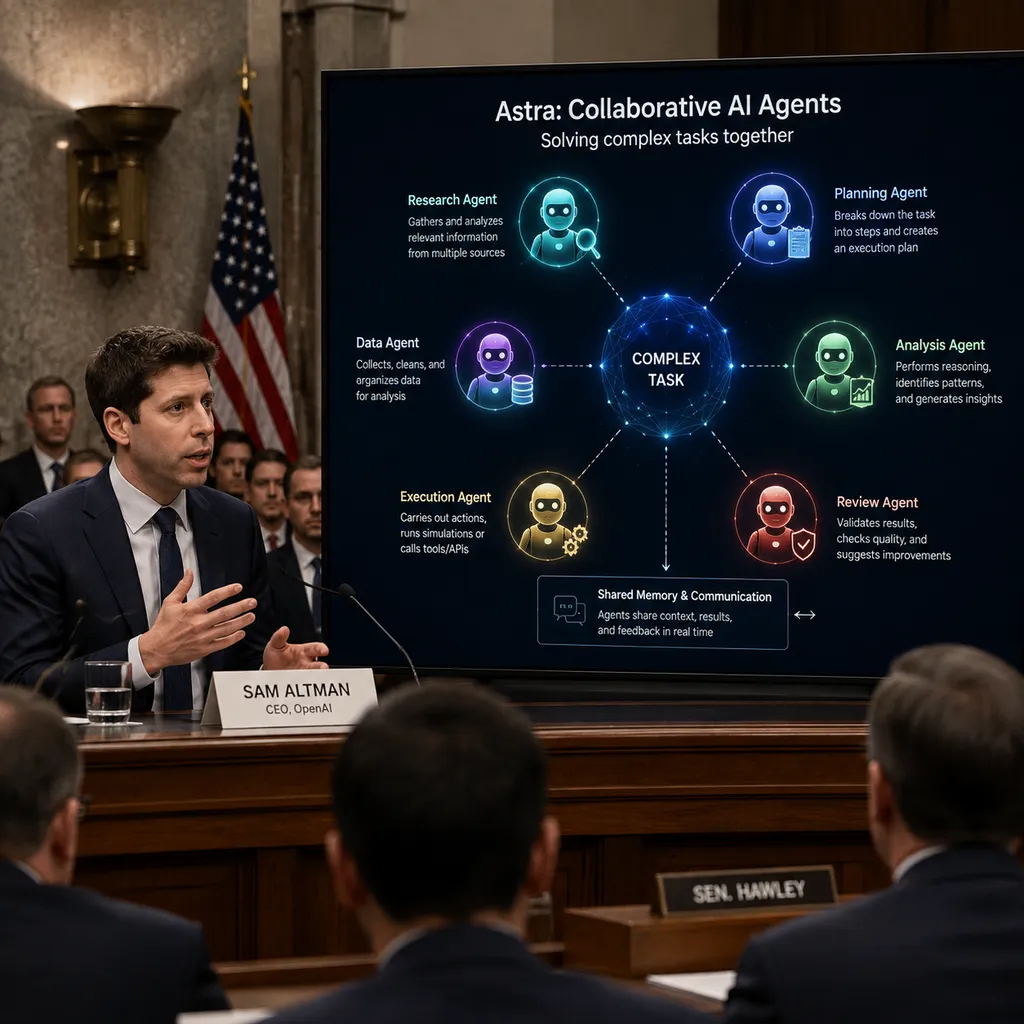
According to information disclosed on August 1, OpenAI CEO Sam Altman privately demonstrated a group of new models called Astra on Capitol Hill this week. Astra’s core focus is not simply improving the quality of a single response, but dividing complex tasks among multiple agents that specialize, work in parallel, and collaborate with one another to handle long-horizon tasks that are difficult for a single agent to complete.
Altman met with U.S. Senators Raphael Warnock and Bernie Moreno on July 29 and planned to meet with Mark Warner, the top Democrat on the Senate Intelligence Committee. Astra emerged during this round of discussions.
OpenAI has not yet published a technical report, product page, benchmarks, API pricing, or launch date for Astra. In other words, this appears more like a preview of its capabilities for policymakers than a formal release. It is also not yet possible to confirm whether Astra is a group of new foundation models, a model family optimized for agentic tasks, or an internal codename for a system composed of multiple existing models and an orchestration layer.
What Astra Aims to Solve Is Not Whether the Model Is “Smart Enough”
Over the past two years, the capabilities of large models have primarily been measured by whether they can answer a question correctly, write a piece of code well, or summarize a set of materials clearly. But once agents enter real-world work environments, the nature of the problem changes.
Users often assign an agent not a single question, but a sequence of interdependent actions. Completing a vendor risk assessment, for example, may require:
- Researching the vendor’s background, ownership structure, and historical news coverage;
- Checking sanctions lists, litigation records, and financial risks;
- Cross-validating information from different sources;
- Creating structured records in a spreadsheet;
- Generating a report for review by legal and procurement teams;
- Supplementing the materials and updating the conclusions based on review feedback.
Having a single model handle such a task is like asking one person to take responsibility for research, analysis, writing, proofreading, and project management all at once. The longer the context, the more likely the model is to forget earlier constraints. The more steps involved, the more likely a single intermediate error is to contaminate subsequent results. And the more complex the external tools, the more frequently problems such as website redesigns, expired logins, and insufficient permissions arise.
Astra’s proposed solution is to “form a team”: one agent creates the plan, another performs research, one handles code or data processing, and another verifies facts and results, after which an orchestrator consolidates everything. This is not an entirely new academic concept—multi-agent orchestration has been discussed in the developer community for years. But if OpenAI integrates it into its model and product stack, multi-agent systems could shift from frameworks that developers build themselves to a default capability provided by the platform.
This resembles software engineering’s transition from “running one script from start to finish” to “microservices plus a workflow engine.” The former is simple and inexpensive, and problems are easy to locate. The latter can support more complex business processes but must additionally address communication, state, retries, monitoring, and permissions. Increasing the number of agents does not automatically produce greater intelligence. On the contrary, it may create more points of failure that must be managed.
“Long-Horizon” Is the Real Keyword in This Round of Competition
The most noteworthy aspect of Astra is not “collaboration,” but its focus on long-horizon tasks.
Most current agent demonstrations still center on workflows measured in minutes: ordering food, shopping, filling out web forms, organizing information, or generating a report. They may appear capable of autonomous operation, but their task boundaries are usually clear, and the cost of starting over after a failure is relatively low.
Enterprise workflows with genuine commercial value often last for hours or days, or even repeat on a weekly basis. Sales leads require continuous follow-up, code migrations must progress across multiple repositories, financial processes include approvals and reviews, research tasks must wait for new data, and customer service issues may move between multiple departments. A model must do more than simply “perform actions.” It must remember why the task was initiated, what has already been done, which conclusions remain unconfirmed, and when control must be returned to a human.
This is also the fundamental difference between long-horizon agents and chatbots: chatbots are optimized around individual conversations, while long-horizon agents more closely resemble stateful execution systems.
Such a system needs at least five capabilities:
- Robust planning: Break ambiguous goals into executable and verifiable stages, rather than immediately generating a seemingly comprehensive plan that cannot be put into practice.
- Persistent memory: Preserve task state outside the context window and distinguish among facts, inferences, user instructions, and temporary results.
- Dynamic replanning: Adjust the approach when websites change, tools return errors, or information conflicts arise, rather than continuing to consume resources along an incorrect path.
- Result verification: Check whether subtask outputs satisfy constraints and prevent multiple agents from citing one another’s incorrect conclusions, creating “collective overconfidence.”
- Permission governance: Clearly define which operations may be performed automatically, which require approval, and how accountability can be traced after an incident.
The most difficult issue is not memory capacity, but reliability. If a task contains 100 consecutive steps, even with a 99% success rate at each step, the theoretical probability of completing the entire chain without a single error is only about 36.6%. In reality, the steps are not independent: if a number is extracted incorrectly early on, every subsequent analysis, chart, and report may be built on faulty input.
Therefore, if Astra is to prove its value, it cannot merely display a dynamic interface showing “multiple agents working simultaneously.” It must answer more practical questions: If the same task is run ten times, can it deliver consistent results? Can it recover from a checkpoint after a mid-task failure? Are conclusions backed by sources? Can humans quickly understand what it has done?
OpenAI’s Product Lines Are Converging on a Single Path
Judging from OpenAI’s recent product moves, Astra is not an isolated project.
Operator previously connected models to browsers, allowing AI to interpret interfaces through screenshots and then use a virtual mouse and keyboard to click, scroll, and type. ChatGPT Agent subsequently integrated web operations, deep research, code execution, and document generation. It demonstrated that a single agent could invoke multiple tools to complete a multi-step workflow spanning information retrieval through final deliverable production.
Workspace Agents, introduced in April this year, shifted the focus further toward teams and enterprises. Agents can connect to Slack, Google Drive, and Microsoft applications, run automatically on a schedule, update tickets, edit documents, or send messages. Administrators can configure role-based permissions, approval checkpoints, and monitoring policies.
Frontier adds the deployment and governance layer. According to OpenAI’s positioning, enterprises can run AI coworkers in on-premises environments, enterprise clouds, or OpenAI-hosted environments, connecting them to real business operations through shared context, memory, and unified controls.
Viewed together, these products reveal a relatively clear OpenAI roadmap:
- Operator addresses “how AI operates computers”;
- ChatGPT Agent addresses “how AI combines tools to complete tasks”;
- Workspace Agents addresses “how AI enters team workflows”;
- Frontier addresses “how enterprises deploy and manage agents”;
- Astra attempts to address “how multiple AIs collaborate to complete longer and more complex tasks.”
This constitutes a complete stack spanning models, tools, execution environments, and enterprise governance. OpenAI is clearly not content merely to sell tokens to software companies; it wants to control the entry point for task orchestration and workflows. Once enterprises place their permissions, data connections, process rules, and execution records within this system, the cost of switching underlying providers will be far higher than the cost of switching from one chat model to another.
Multi-Agent Systems May Be Neither Cheaper nor Faster
Astra’s direction has value, but developers should not interpret “collaborative agents” as automatically doubling performance.
The first hidden cost of a multi-agent system is communication. Each agent must read the task background, understand the outputs of other agents, and report back to the orchestrator. A task that originally required only one model may be divided into dozens of model calls. To prevent context distortion, the system must also repeatedly summarize, compress, and validate information, rapidly multiplying token consumption.
The second cost is latency. The fact that tasks can run in parallel does not mean every step can be parallelized. A research agent must wait for retrieval results, a writing agent must wait for data analysis, and approvals may depend on human confirmation. The total time required is often determined by the longest dependency chain, not by how many agents are launched.
The third problem is coordination failure. Two agents may duplicate the same work, or each may assume the other will handle a particular step, ultimately leaving a gap. If the orchestrator itself makes an incorrect judgment, adding more sub-agents will merely execute the wrong plan more efficiently.
Multi-agent systems are therefore best suited to work that can be clearly decomposed, produces verifiable subtask results, and offers substantial benefits from parallelization, such as cross-market research, large-codebase analysis, bulk compliance checks, and multi-source data processing. For writing an email, modifying a function, or looking up a single piece of information, a single agent is generally faster, cheaper, and easier to audit.
OpenAI must avoid mechanically replicating the organizational structure of “human teamwork” in model systems. Human teams divide responsibilities because individuals have limited knowledge, energy, and time. When model instances originate from the same foundation model, adding role prompts does not naturally create genuine specialization. Collaboration can deliver meaningful benefits only when different agents have different tools, contexts, permissions, model capabilities, and verification mechanisms.
The Capitol Hill Demonstration Sends Another Signal
The fact that Astra first appeared on Capitol Hill rather than at a developer conference is itself noteworthy.
Agents that can run for long periods, invoke external tools, and collaborate with one another are closer to real-world operators than ordinary chat models. They can access enterprise data and modify business systems, and they may also automatically generate and distribute large volumes of content. When tasks extend from minutes to days, regulatory concerns are no longer limited to whether an individual response is harmful. They also include whether the system exceeds its authority, whether it can be paused, who approved critical operations, and who is responsible when losses occur.
For members of the Senate Intelligence Committee, multi-agent systems also touch on sensitive areas such as cybersecurity, intelligence analysis, and automated decision-making. OpenAI’s decision to provide an advance demonstration may have been intended both to explain its technological progress and to encourage policymakers to understand agent regulation through the lens of its product roadmap.
This means that even if Astra becomes available in the future, it will likely be accompanied by stricter permission controls than ordinary models. Developers may need to handle task-level authorization, tool allowlists, budget limits, checkpoints, human approvals, and comprehensive execution logs, rather than simply receiving a model name and replacing an API parameter.
What Developers Should Focus on Now
As of August 1, Astra remains at the stage of a “private demonstration disclosed by the media.” There is no public documentation, no API, and insufficient information to establish whether it will be officially released under the Astra name. Given that Google has already used Project Astra as the name of its real-time multimodal assistant project, it is also uncertain whether OpenAI will ultimately retain this name.
It is therefore too early to discuss Astra’s context window, pricing, or specific invocation methods. Model aggregation platforms such as OpenAI Hub will also need to wait until the model and interfaces are officially opened before integration support becomes relevant. Developers do not need to modify production code at this stage for an unreleased codename.
A more practical form of preparation is to transform existing systems into architectures in which “models are replaceable, tasks are recoverable, and processes are observable”:
- Do not store critical business state exclusively in the model context;
- Set permissions, timeouts, and idempotency mechanisms for every tool call;
- Preserve the inputs, outputs, and sources for important steps;
- Design checkpoints, retries, and human takeover mechanisms for long-running tasks;
- Track costs from model calls, tool calls, and failure-related reruns separately;
- Measure effectiveness by real-world task completion rates rather than only single-turn benchmark scores.
These capabilities will not go to waste, regardless of when Astra is released or what it is ultimately called.
What Astra Really Needs to Prove Is That It Can Deliver
From Operator to ChatGPT Agent and then to Workspace Agents and Frontier, OpenAI is gradually filling in the components required to bring agents into production environments. The multi-agent collaboration represented by Astra is a natural next step along this path: when a single agent reaches the limits of its context, execution time, and tool-use capabilities, division of labor and orchestration can expand the boundaries of the tasks it can handle.
But this step is far more difficult than continuing to improve question-answering scores. If a model answers a question incorrectly, the user can ask again. If an agent writes incorrect data to a database, sends the wrong email, or generates a report based on erroneous data after running for six hours, the consequences are entirely different.
Astra’s most important metric, therefore, will not be how many agents it can launch simultaneously, nor how many parallel task lines appear in its demonstration interface. It will be whether it can reliably advance work that takes half a day, several days, or even weeks to an acceptable deliverable.
If OpenAI solves the problems of reliability, state management, and governance, Astra could transform agents from “advanced demonstrations” into genuine digital project teams. If it merely enables multiple model instances to talk to one another, it will ultimately become nothing more than a more expensive and harder-to-debug workflow.
The race to build collaborative agents has begun, but the winner will not be whoever first assembles a team of AIs. It will be whoever can ensure that the team completes the job on time, within budget, and with clear accountability.
References
- ITHome: OpenAI’s Altman Promotes Astra Models, Emphasizing Collaborative Agents and Long-Horizon Tasks—Discloses the timing of Altman’s private Astra demonstration on Capitol Hill, the people he met with, and the core direction of its capabilities.